


 329 / 392

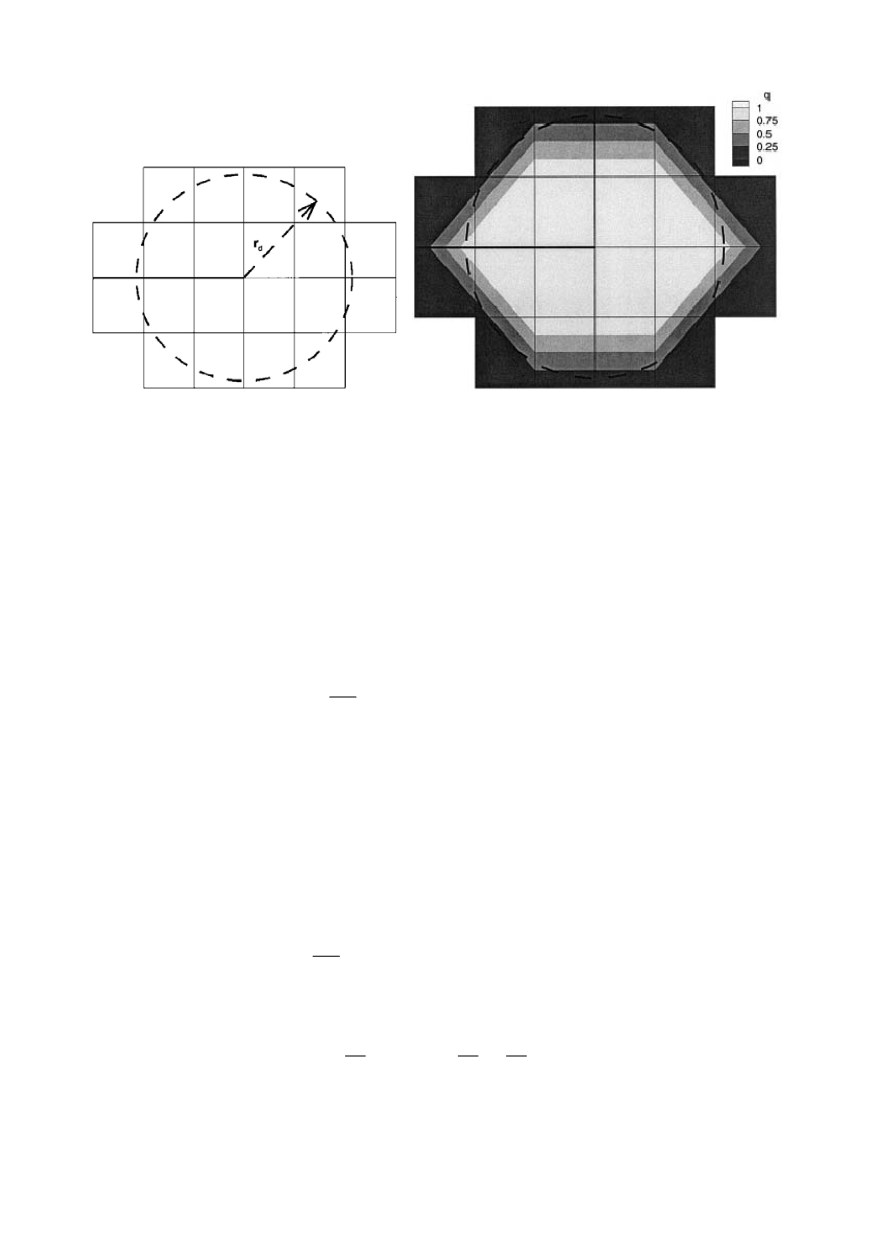
Figure 3. Weight function
q
on the elements
2. THE ESTIMATION OF FATIGUE LIFE
Unstable crack propagation occurs when one of the stress intensity factors
K
α
(
α
=
I,II,III) is equal or greater than the experimentally determined material property
K
c
. The
estimation of fatigue life can be updated for each crack extension. The crack growth
equation provides a relation between the crack increment
∆
a
and the increment in the
number of load cycles
∆
N
. In case of cyclically loaded structures, the number of load
cycles equivalent to the crack increment can be determined by a numerical integration of
the governing crack growth equation [11].
The Paris law is a simple but very often used model of crack growth rate description in
the linear region under mode I. This law has the form
m
da C K
dN
= ∆
(17)
where
∆
K
is the stress intensity factor range, and
C
and
m
are material constants. For
most materials,
m
is between 2 and 7, while
C
is more material-dependent. A shortcoming
of the Paris law is that it neglects the influence of the peak stress and the threshold range.
Growth of cracks under mode I and mode II was first systematically studied by Iida
and Kobayashi [12]. Results of their experiments showed that even a small
∆
K
II
increase
would significantly increase crack growth rate. However, they also observed that the
crack tended to grow in the direction of minimum
K
II
. Some models take into account the
mode II contribution. One way is by introducing an equivalent stress intensity factor
∆
K
I
eq
in the Paris equation
I
(
)
m
eq
da C K
dN
= ∆
(18)
The maximum stress criterion can also be used to determine the equivalent mode I
stress intensity factor, according to the following expression
3
2
I
I
II
cos
3 cos sin
2
2
o
o
eq
K K
K
θ
θ
=
−
2
o
θ
(19)
where
θ
o
denotes the direction in which the crack is likely to propagate relative to the
crack tip coordinate system, and
∆
K
I
eq
is found to be the
K
I
eq
range during one load cycle.
325