


 335 / 392

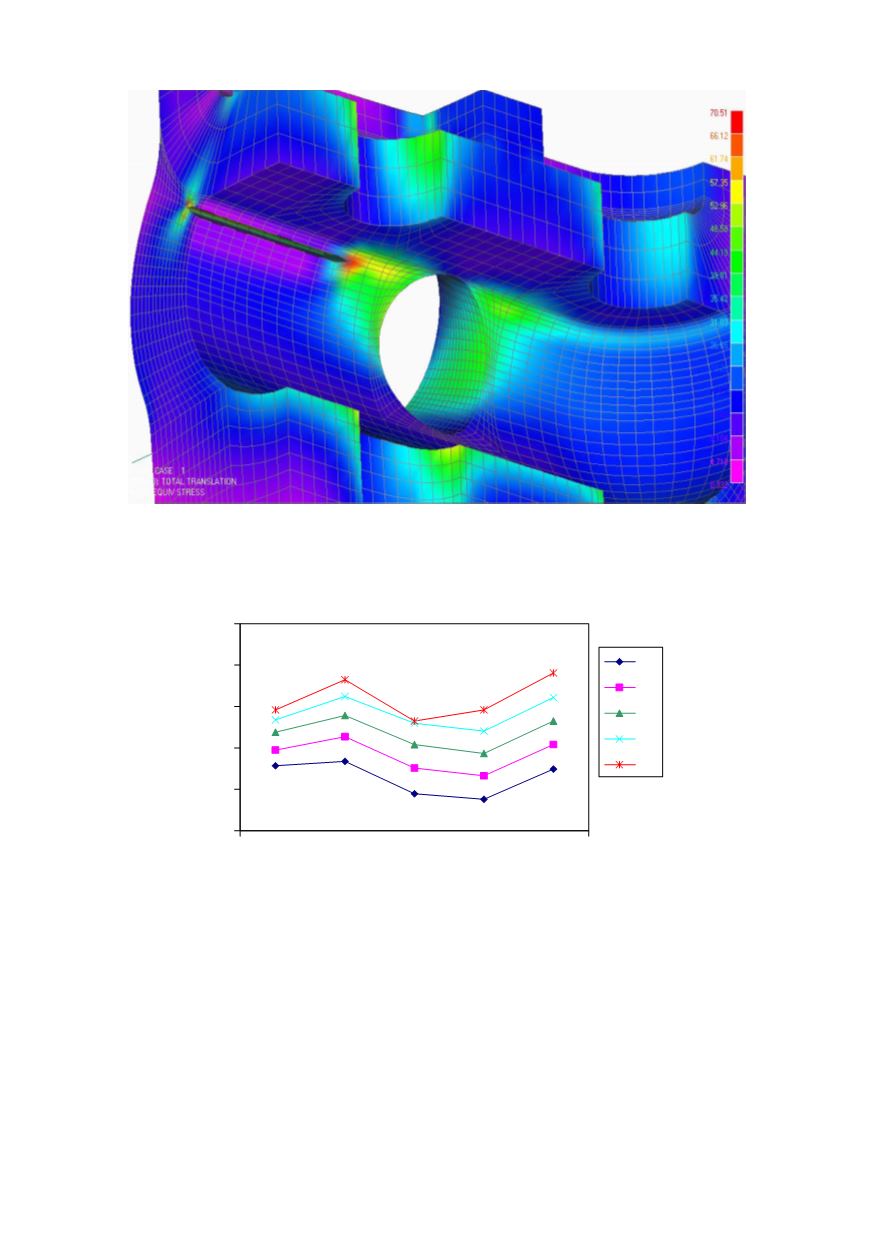
Figure 11. Field of the effective stress in the vicinity of the crack (375
×
30)
Dependence of stress intensity factor on crack length and depth is shown in Fig. 12. It
is observed that increase in crack depth from 20 to 40 mm, for constant crack length,
leads to the increase of stress intensity factor from 15 to 30%.
5
6
7
8
9
10
90
150
225
300
375
20
25
30
35
40
Figure 12. Dependence of stress intensity factor on crack length and
crack depth (20, 25, 30, 35, and 40 mm)
CONCLUSIONS
Based on the equivalent domain integral (EDI) method, very robust, efficient and
reliable procedure for numerical estimation of stress intensity factors is obtained. Appli-
cation of the
J
–EDI integral is suitable because it relies on use of domain integrals rather
than contour integrals. Obtained numerical results show a small influence of the choice of
J
-integral domain integration on the value of stress intensity factor. In addition to
relatively simple test cases, the analysis of complex 3-D problems is presented. The
analysis shows that a stable crack growth is predicted in nominal regime of the analyzed
structure, while 2-D analysis shows a rapid increase of the stress intensity factor for crack
depth increase over 50 mm.
331