


 326 / 392

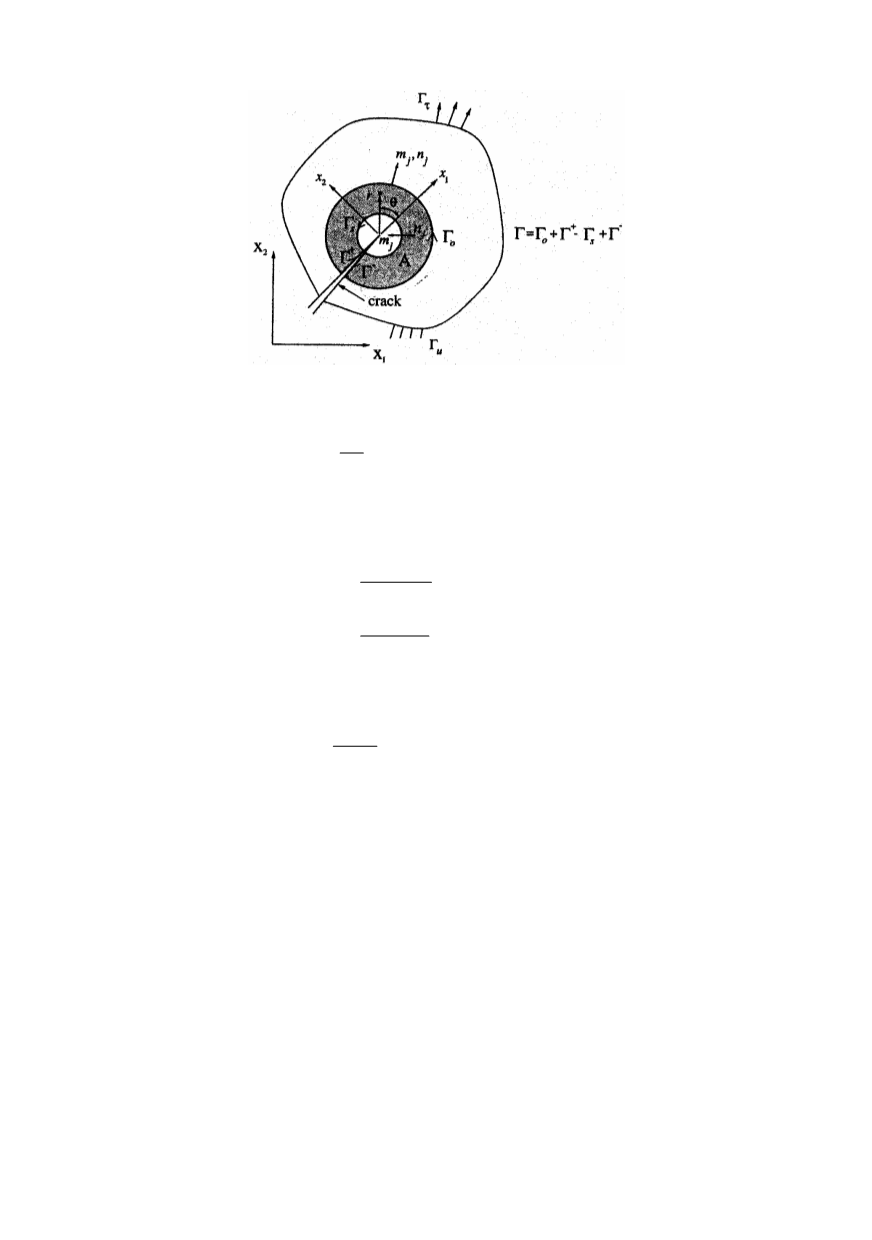
Figure 1. Conversion of the contour integral into an Equivalent Domain Integral method (EDI)
Helen and Blackburn [3] showed that
2
2
1 2
I
II
I II
*
1 (
2
)
J J iJ
K K iK K
E
= − =
+ +
(4)
where
K
I
and
K
II
are stress intensity factors for modes I and II, respectively. Thus, values
of energy release rates (
J
1
and
J
2
) for crack extension perpendicular and parallel to the
crack, respectively, will be given by:
2
2
I
I
1
*
I II
1
*
2
K K
J
E
K K
J
E
+ =
−=
I
(5)
where
*
2
plane strain
plane stress
1
E
E E
v
⎧
⎪
=
⎨
⎪
−
⎩
Note that solution Eq. (5) is the intersection of a circle and hyperbola. Hence, there
exists more than one pair of stress intensity factors.
The contour integral (1) is not in a form best suited for finite element calculations. The
contour integral is therefore recasted into an equivalent domain form. The equivalent
domain integral method (EDI) is an alternative way to obtain the
J
-integral. The contour
integral is replaced by an integral over a finite-size domain. The EDI approach has the
advantage that effects of variable body forces can easily be included. The standard
J
-
contour integral given by Eq. (1) is rewritten, by introducing a weight function
q
(
x
1
,
x
2
)
into the EDI. Hence, the following contour integral is defined
1
,1
(
)
j
ij i
j
W u m q
δ
σ
Γ
Ψ =
−
Γ
∫
d
(6)
where the contour is
Γ
=
Γ
0
+
Γ
+
–
Γ
S
+
Γ
–
(Fig. 1),
m
j
is an outward unit vector normal to
the corresponding contour (i.e.
m
j
=
n
jon
Γ
0
and
m
j
= –
n
jon
Γ
S
), and
q
is a weight function
defined as
q
= 1 inside contour
Γ
, and
q
= 0 for the domain outside
Γ
(Fig. 2, Fig. 3b).
322