


 386 / 392

the net section from primary loading (internal pressure), while the secondary stress is not
taken into account
[
25
]
.
Net section stress for defect No.970-64 is
σ
n
= 1.08
pR/t
, where the 1.08 factor takes
into account the weakening of the 50 mm section thickness due from a 4 mm long crack,
so that the following is obtained:
(
)
(
)
1.08
1.08 8.1 1075
2
2
500 650 0.33
50
n
R
eH M
F
pR
S
R R
t
σ
σ
⋅
⋅
⎛
⎞
⎛
⎞
= =
+ =
+ =
⎜
⎟
⎜
⎟
⎝
⎠
⎝
⎠
(9)
where data for
R
eH
and
R
M
were taken from the project documentation for base metal (for
weld metal they do not differ much). Effects of the vicinity of the dish cover have been
ignored, as the discontinuity occurring causes significant change of stress in a torus part
of the dish cover, but not in the cylindrical part [18
]
.
The stress in net section of defect No.978-14 is
σ
n
= 1.05
pR/2t
= 95 MPa, with the
section weakening coefficient of 1.05 (the 2 mm long crack for thickness of 42 mm), so
that the following is obtained:
95 0.17
575
n
R
F
S
σ
σ
= = =
(10)
The influence of the vicinity of the dish cover is again taken to be negligible
[
18
]
.
The net section stress for defect No.971-57 is
σ
n
= 1.05
pR/2t
= 87 MPa, where section
weakening coefficient is not taken into account as its influence is negligible, so that the
following is obtained:
87 0.15
575
n
R
F
S
σ
σ
= = =
(11)
Based on values obtained for
K
I
/K
I
c
and
σ
n
/
σ
F
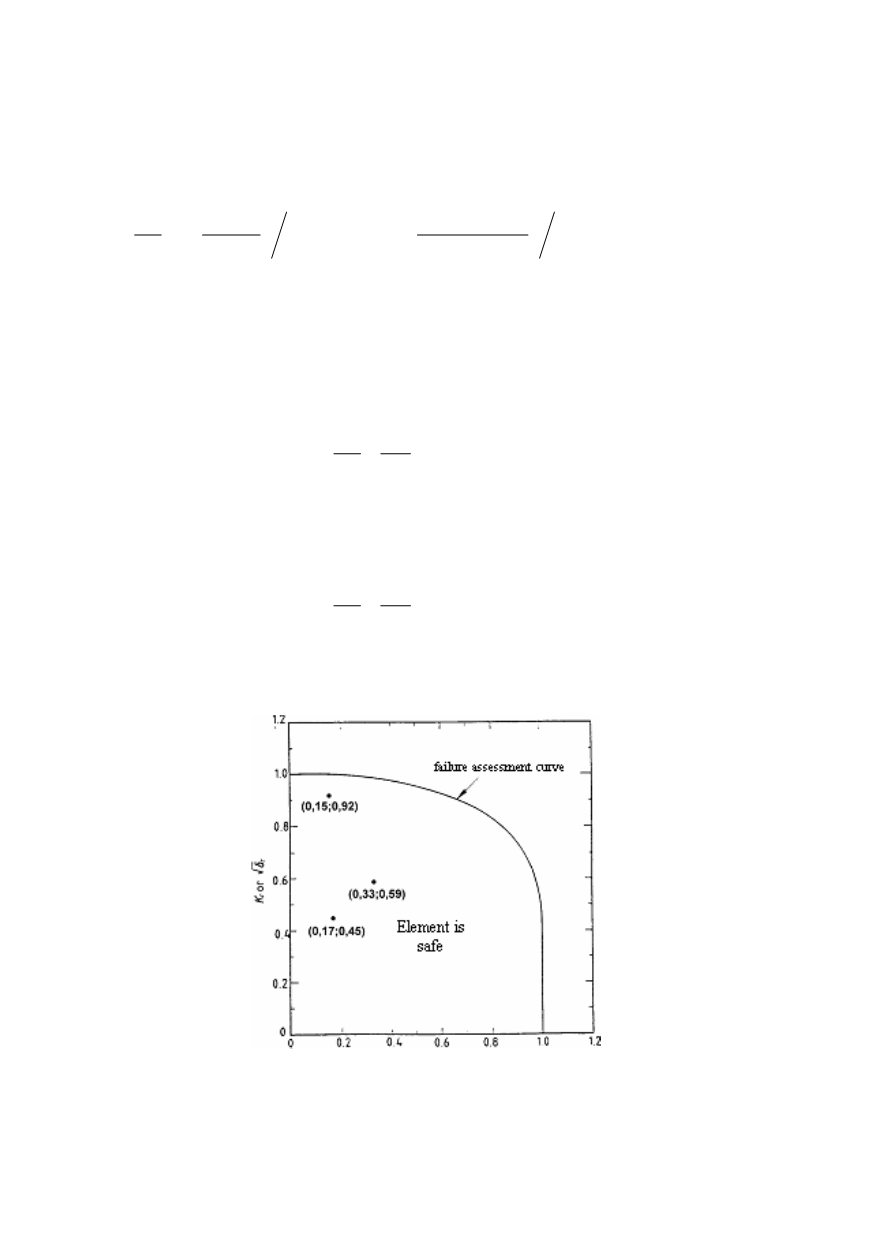
, the points (0.33; 0.59), (0.17; 0.45),
and (0.15; 0.92) are plotted in the failure analysis diagram (FAD), all located in the safe
part of the diagram, Fig. 11.
S
r
Figure 11. Failure analysis diagram for damaged vessels
382
Having in mind the conservatism of this analysis in all its aspects, it may be concluded
that the vessels are safe not only from brittle fracture, but from the plastic collapse, too. It
is essential to note that the FAD enables simple analysis of the integrity that may reliably