


 377 / 392

APPLICATION OF FRACTURE MECHANICS IN
ASSESSMENT OF STRUCTURAL INTEGRITY
Aleksandar Sedmak, Faculty of Mechanical Engineering, Belgrade, S&Mn
Marko Rakin, Faculty of Technology and Metallurgy, Belgrade, S&Mn
INTRODUCTION
Fracture mechanics is a scientific discipline related to cracks and their effects on the
behaviour of various materials and structures. Fracture mechanics (originally referred to
as crack mechanics) started to develop at the beginning of the XX century, with the
papers of Inglis on stress concentration
[
1
]
and Griffith, on energy releasing rate
[
2
]
. In
the fifties Irwin established foundations of linear elastic fracture mechanics by introduc-
ing the stress intensity factor and its critical value
[
3,4
]
. At that time fracture mechanics
registered first significant successes in practice by explaining failure of Liberty ships and
Comet jet airplanes
[
5
]
. Further development of this scientific discipline included its
expansion to the elastic-plastic field, using the analysis of a plastic zone in front of a
crack tip
[
5,6
]
and the introduction of proper parameters – crack tip opening displacement
[
7
]
and
J
integral
[
8
]
. As a matter of course, the development of fracture mechanics in
some other important fields such as fatigue,
[
9
]
, creep
[
10
]
, and corrosion
[
11
]
followed.
Practical application of fracture mechanics is from the very beginning based on the
interpretation of its parameters; on one hand, they represent loading and structural geome-
try, and on the other they represent material properties and its resistance to crack growth.
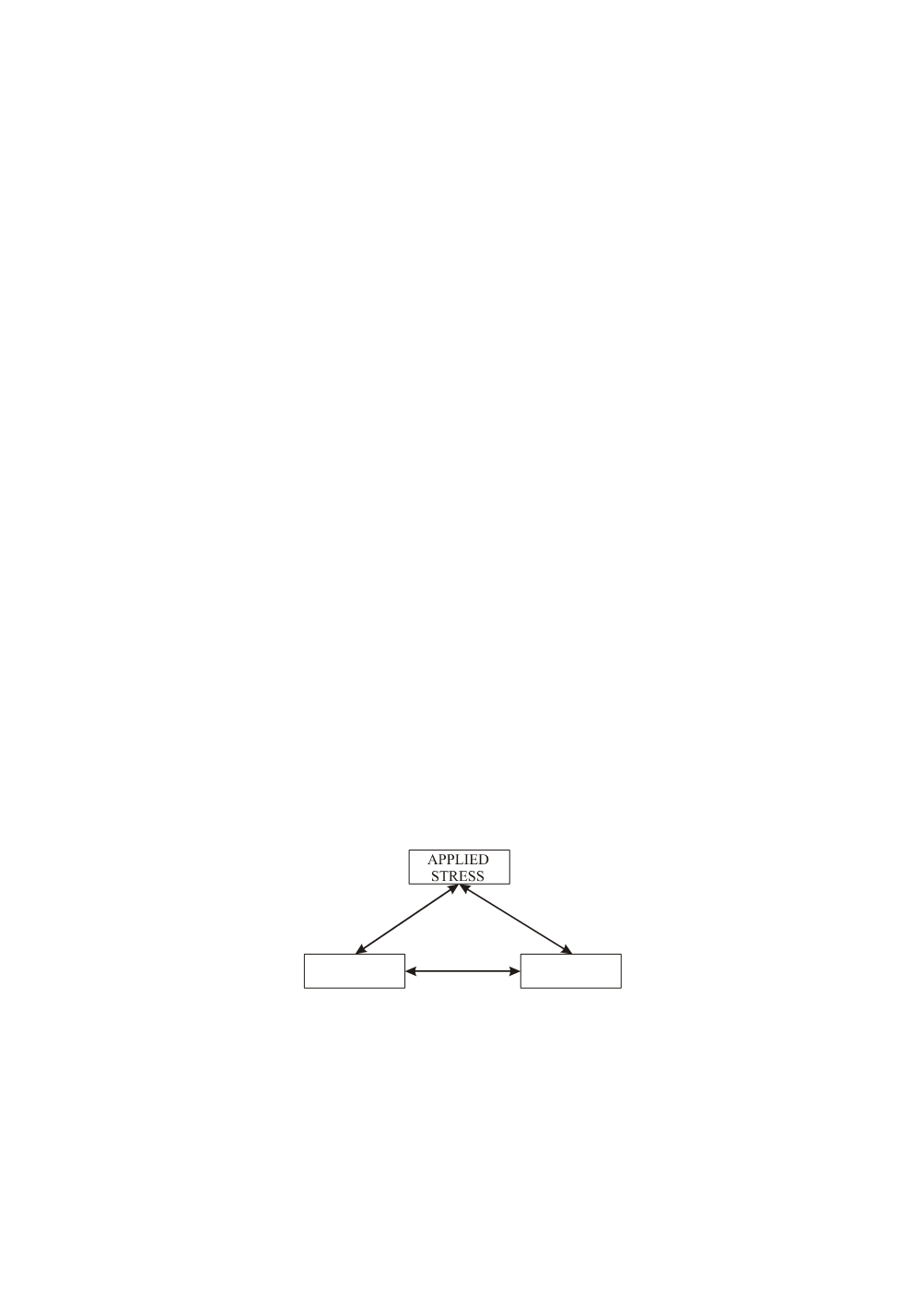
In that way the triangle of fracture mechanics has been established, Fig. 1, enabling frac-
ture mechanics to become one of the foundations of a new discipline – structural integ-
rity. In other words, instead of only handling fracture analysis, fracture mechanics has
become an important tool in the hands of engineers whose job is to prevent fracture.
CRACK
DIMENSIONS
FRACTURE
TOUGHNESS
FRACTURE
MECHANICS
Figure 1. Fracture mechanics triangle
Fracture mechanics has brought significant changes in engineering practice. As an
example to illustrate this statement, the problem with the Alaska pipeline and application
of the fracture-safe principle in design may be mentioned. In case of the pipeline from
Alaska to the rest of the USA, the fracture mechanics criteria were adopted instead of
traditional standards on admissible defects in a welded joint
[
12
]
. Namely, when non-
destructive testing revealed a large number of defects in round welded joints which,
according to the then effective standards, should have been repaired, the question of eco-
nomic justification, i.e. necessity of repair, arose. Therefore, the institution in charge,
373