


 339 / 392

tion of allowed stress is determined on the basis of known distribution of the working and
critical stresses and for the chosen value of reliability.
The elementary reliability relates to the possibility of occurrence of certain kinds of
defects, i.e. failures. The unreliability,
F
p
= 1 –
R
, is a complex probability of the
occurrence probability of service stress, and of the probability of failure at that stress. For
fracture to occur due to fatigue, it is necessary that stress occurs in the machine part and
that the possibility of fatigue (fracture) exists at that stress. Fracture occurs if both indi-
cated conditions are satisfied, i.e. the probability represents the integral of the product of
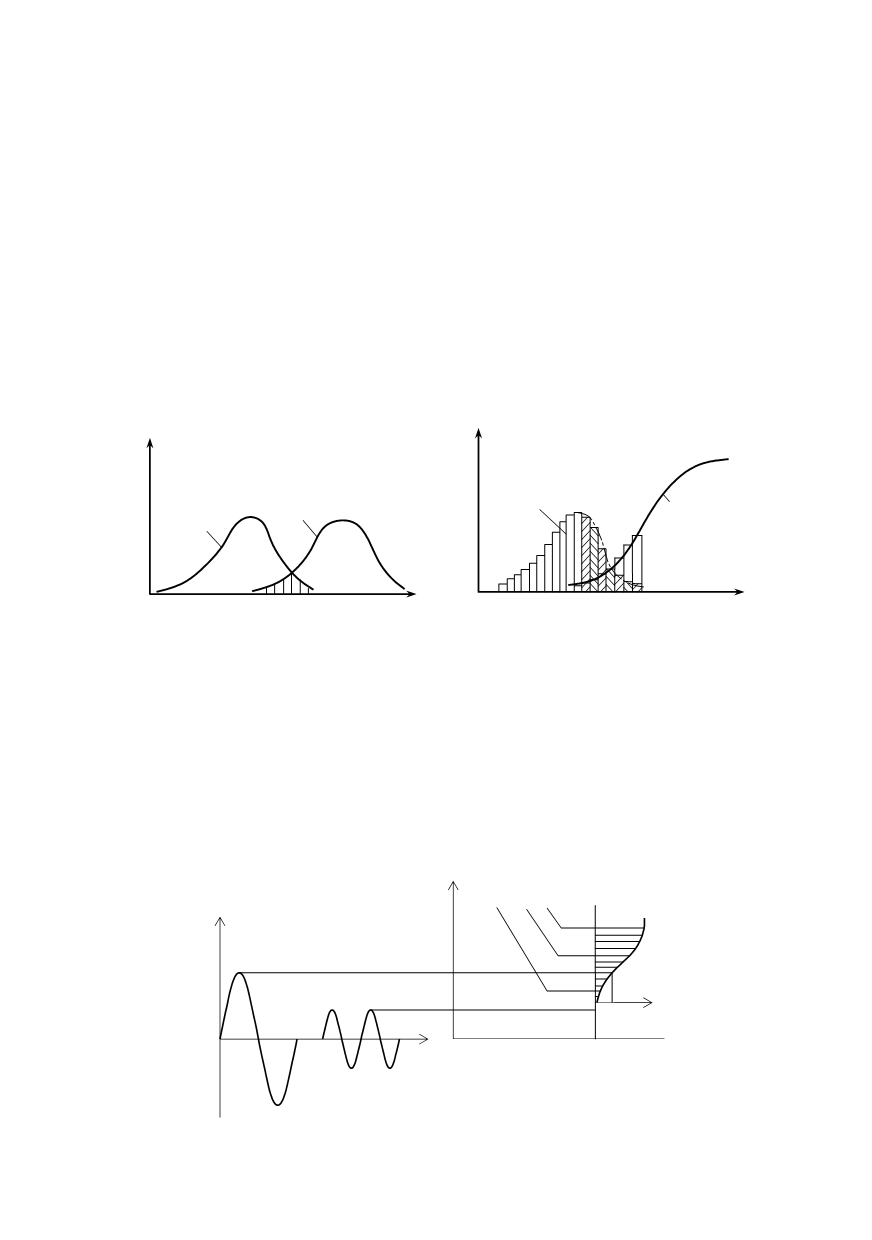
the density of these probabilities and is proportional to the overlapping area in Fig. 2a.
The integration is obtained numerically and turns into the sum of the product of the
density of stress probability
f
i
and failure probability
P
Ri
which represents the cumulative
(integral) probability of critical stress.
1
k
p
i Ri
i
F p P
=
=
∑
;
1
k
p
i Ri
i
F f P
=
=
∑
;
( ) ([ ])
p
F f
f
d
σ
σ
+∞
−∞
=
∫
σ
f
(
σ
)
P
R
(
σ
)
σ
Probability
f
(
σ
)
f
(
[
σ
]
)
σ
Density
a)
b)
Figure 2. Relation of the probabilities of service and critical stresses and reliability determination
If the number of different service stresses
i
is small, the probability density
f
i
turns into
the statistical weight
p
i
. It can be determined as the ratio of stress fluctuation
σ
i
cycles
number in the length of service
n
Σi
and the total number of stress cycles in the length of
service
n
Σ
, i.e. as
p
i
=
n
Σi
/
n
Σ
. If a machine part is exposed to a fluctuating stress of
constant amplitude, the statistic weight, i.e. the possibility of the occurrence of such stress
is
p
(
σ
) =
n
Σ
/
n
Σ
= 1, thus the unreliability is equal to failure probability
P
R
(
σ
). If a machine
part is exposed to stresses of different amplitudes (Fig. 3), the statistical weight of each is
p
i
=
n
Σi
/
n
Σ
(
n
Σ
= ∑
n
Σi
). In that proportion, the failure probabilities
P
Ri
have an impact on
the unreliability
F
p
(Fig. 2b and Fig. 3). The unreliability is equal to the sum of products
of statistic weight and failure probability for each one of the stress values.
σ
σ
σ
’
σ
N
n
Σ
P
R
(
σ
)
P
R
Figure 3. The relation of failure probability and work stress in the range of infinite life strength
335