


 317 / 392

information but the user is “rewarded” by less conservative results. An unacceptable
result provides a motivation for repeating the analysis at the next higher level rather than
claiming the component to be unsafe. The SINTAP standard analysis levels are:
Basic Level – Only the toughness, yield strength, and ultimate tensile strength of the material need
to be known. Different sets of equations are offered for materials with and without
Lüders plateau.
Mismatch Level – This is a modification of the Basic Level for inhomogeneous configurations
such are strength–mismatched weldments.
Advanced or Stress-Strain Level – This requires toughness data and the complete stress-strain
curve of the material. Both, homogenous and strength mis-
matched components can be treated.
There are additional levels:
Default Level – Only the yield strength of the material is required. The fracture resistance of the
material can be conservatively estimated from Charpy data.
Constraint Level – Within this level, the effect of loss of constraint in thin sections or predomi-
nately tensile loading on fracture resistance is considered.
J
–integral Analysis Level – This level includes a complete numerical analysis of defect structure.
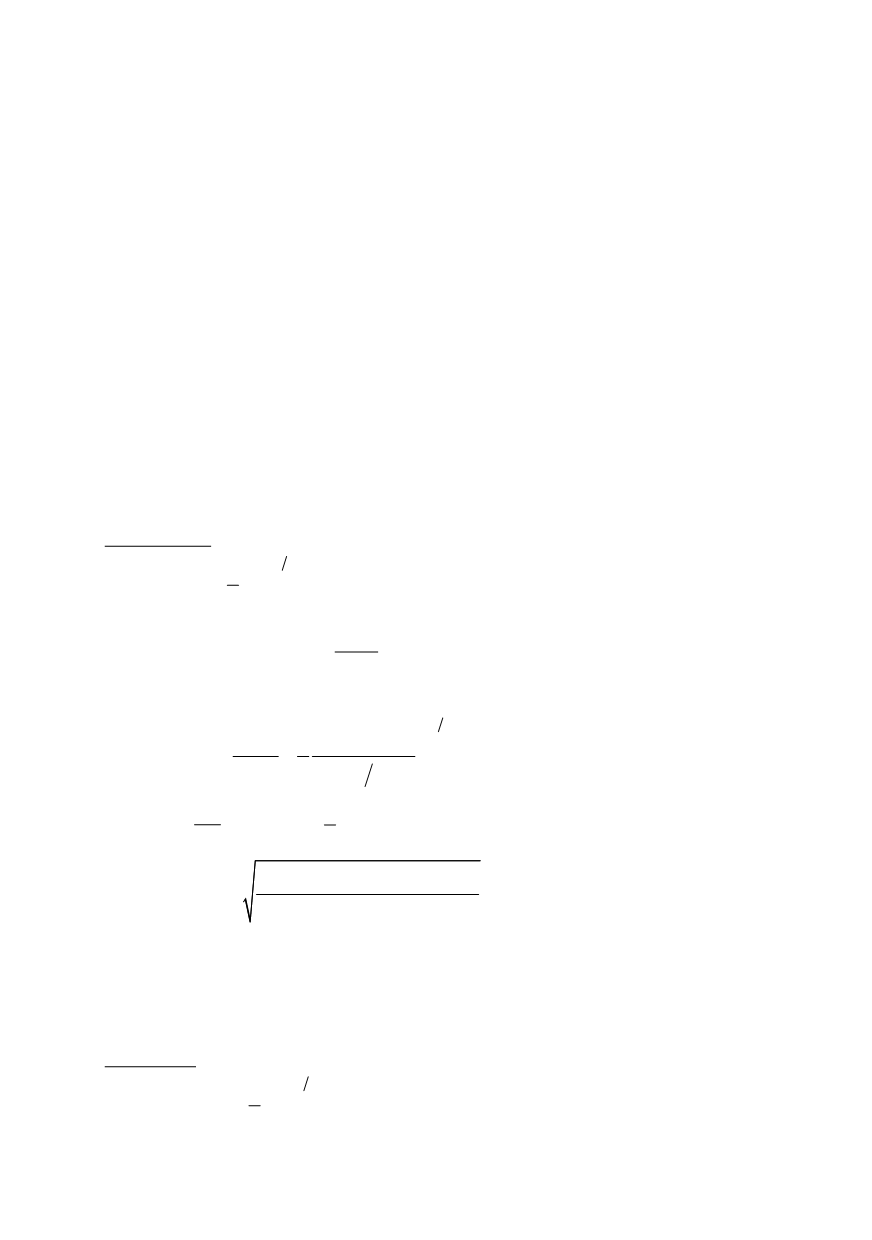
In the present paper the Default, Basic and Advanced Levels are applied. The accord-
ing equations
f
(
L
r
) for ferritic steels without Lüders plateau are:
– Default Level
(
)
1 2
2
6
1
( ) 1
0.3 0.7exp 0.6
2
r
r
r
f L
L
L
−
⎡
⎤ ⎡
⎤
= +
+
−
⎢
⎥ ⎣
⎦
⎣
⎦
for 0 ≤
L
r
≤
L
r max
(11)
2.5
0.2
150
1
r max
p
L
R
⎡
⎤
= +
⎢
⎥
⎢
⎥
⎣
⎦
,
R
p
0.2
in MPa
(12)
The fracture toughness is estimated in a conservative manner from Charpy data by
(
)
1 2
2
1
( )
2
ref
r
r
ref
ref
ref
E
L
f L
E
ε
σ
ε
σ
−
⎡
⎤
⎢
⎥
=
+
⎢
⎥
⎣
⎦
for 0 ≤
L
r
≤
L
r max
(13)
f
r max
Y
L
σ
σ
=
with
1 (
2
)
f
Y m
R
σ
σ
= +
on the lower shelf, and by
0.256
1.28 0.133KV
0.2
2
(0.53KV )0.2
1000(1 )
mat
J
E
K K
ν
= =
−
, on the upper shelf
(14)
where
K
mat
is in MPa
√
m; specimen thickness
B
in mm; Charpy energy KV in J.
In addition, SINTAP offers a correlation for the ductile-to-brittle transition based on
Charpy transition temperature for 28 J.
In the present analysis, Eq. (13) was applied for estimating fracture toughness from
Charpy energy.
– Basic Level
1 2
2
6
1
( ) 1
0.3 0.7exp(
)
2
r
r
r
f L
L
L
µ
−
⎡
⎤ ⎡
⎤
= +
+
−
⎢
⎥ ⎣
⎦
⎣
⎦
for 0 ≤
L
r
≤ 1
(15)
313