


 315 / 392

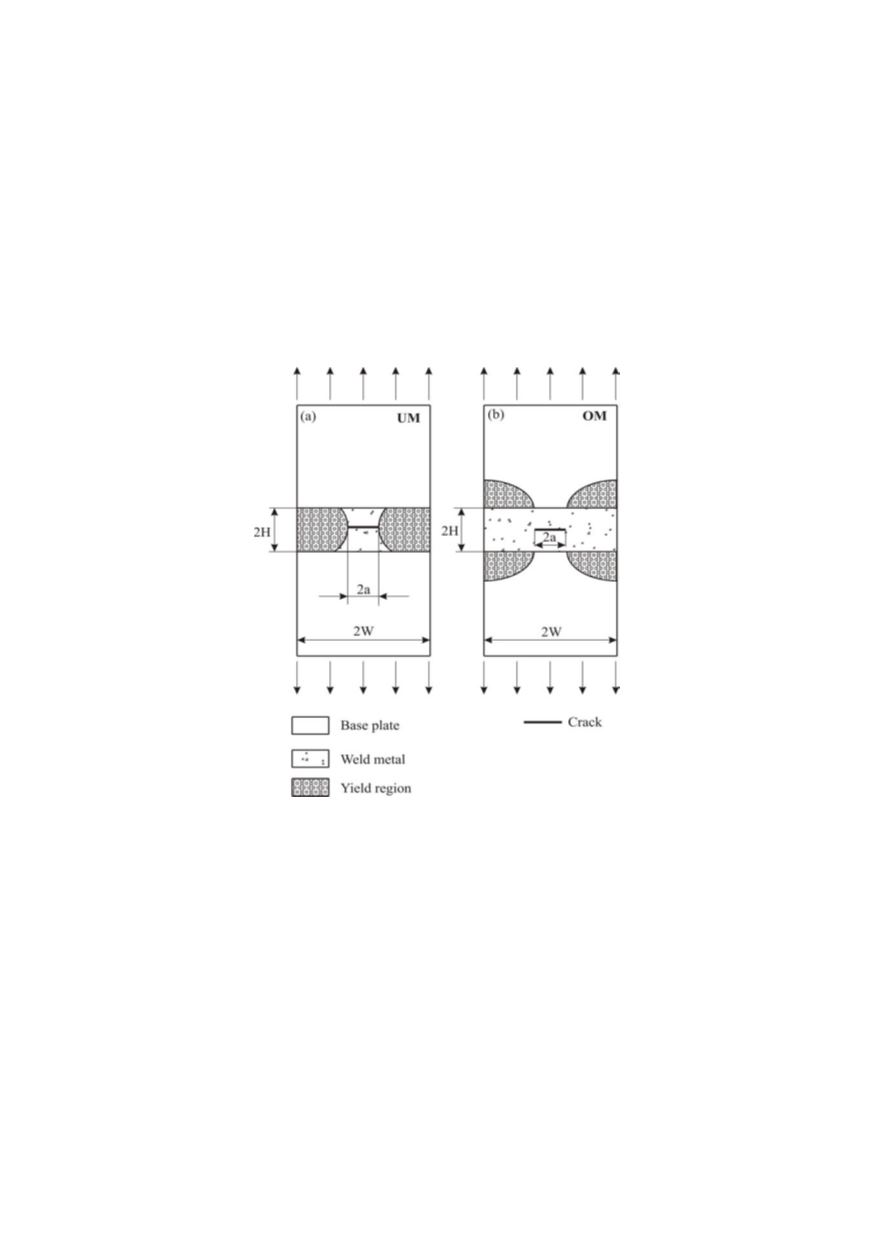
The mechanical consequences of mismatch are obvious from Fig. 13. Overmatching
reduces the strain in the weld metal as compared to the base plate, thus leading to a
shielding of a defect in the weld metal. Undermatching gives rise to a strain concentration
in the weld metal.
There are, however, many cases where strength mismatch is of paramount interest.
The mismatch plays an important role:
•
in fracture toughness of the material (weld metal and base metal), (
K
mat
,
J
mat
, CTOD
mat
),
•
in stress intensity factor solution (
K
I
), in linear-elastic and elastic-plastic deformation
behaviour, and
•
in the limit load solution given by appropriate terms (
F
Y
,
p
Y
,
σ
ref
, etc.)
Therefore, the SINTAP procedure offers separate assessment options for the analysis
of such cases. For the present example mismatch does not play any role.
Figure 13. a) Undermatching (UM) gives rise to a strain concentration in the weld metal;
b) Overmatching (OM) reduces the strain in the weld metal as compared to the base plate
1.5. Plastic limit load
F
Y
311
The plastic limit load of the component with crack is one of the key parameters of the
SINTAP analysis. Here some remarks are due. In solid mechanics the limit load is usually
determined for ideally plastic materials. When the limit load is reached the deformation
becomes unbounded over the cross section. Real materials, however, work harden with
the consequence that the applied force can increase beyond the value given by the non-
hardening limit load. Therefore, in the frame of a fracture mechanics analysis it has to be
distinguished between a plastic collapse load which is identical to the maximum load
which the structure with a crack can sustain and a net section yield load which refers
roughly to that load at which the still unbroken ligament ahead of the crack is first fully
plastic and the local load-deformation curve becomes nonlinear. This parameter as desig-
nated above is the plastic limit load
F
Y
. In practice it is usually determined under the
assumption of an ideally plastic material inserting the yield strength as the maximum